



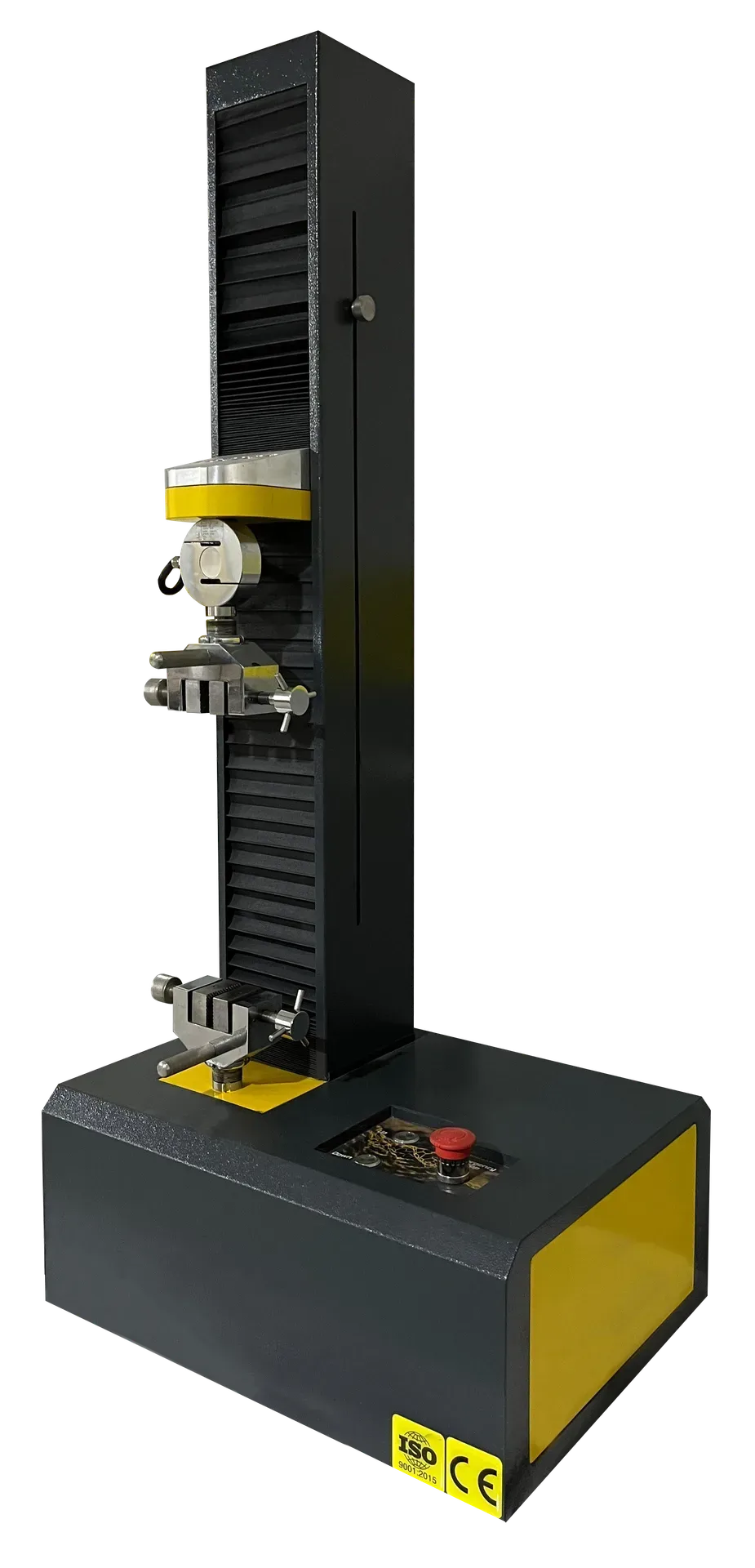
Benchtop Universal Testing Machine (0.5–2 kN)
Vector Tesla Series single-column benchtop universal testing machine for high-precision, low-force material testing — ASTM E4 / ISO 7500-1 Class 0.5.
- iso-7500-1
- astm-e4
- +3 more
View details →
Permanent tensile strain after fracture, usually reported as percentage elongation A using original gauge length L0; depends strongly on L0/specimen proportionality.
Permanent tensile strain after fracture, usually reported as percentage elongation A using original gauge length L0; depends strongly on L0/specimen proportionality.
Formula
A = ((Lu − L0) / L0) × 100%
Lu is gauge length measured after fracture, carefully reunited for metals per ISO 6892-1 / ASTM E8. A is not intrinsic; proportional specimens (e.g. 5.65√S0) are required for comparability.
Elongation at break quantifies ductility: how much tensile strain a material sustains before fracture. It is measured by comparing the final gauge length after specimen halves are fitted together to the original gauge length L0, expressed as a percentage.
Because necking concentrates strain locally, reported elongation is not a material constant—it scales with L0 relative to cross-section (longer proportional gauges average more lightly deformed material outside the neck and show higher A). Standards therefore mandate proportional specimens such as L0 = 5.65√S0 for round bars.
Uniform elongation (strain at onset of necking) better reflects the microstructural capacity for stable plastic flow before localization, but it requires extensometry or digital image correlation rather than post-fracture length measurement alone.
For polymers per ISO 527, thickness and testing speed dominate elongation results; metals and plastics values must never be compared directly without matching standards.
Quality departments use A alongside Rm and Rp0.2 to detect embrittlement from improper heat treatment, contamination, or hydrogen exposure.
Vector Tesla Series single-column benchtop universal testing machine for high-precision, low-force material testing — ASTM E4 / ISO 7500-1 Class 0.5.
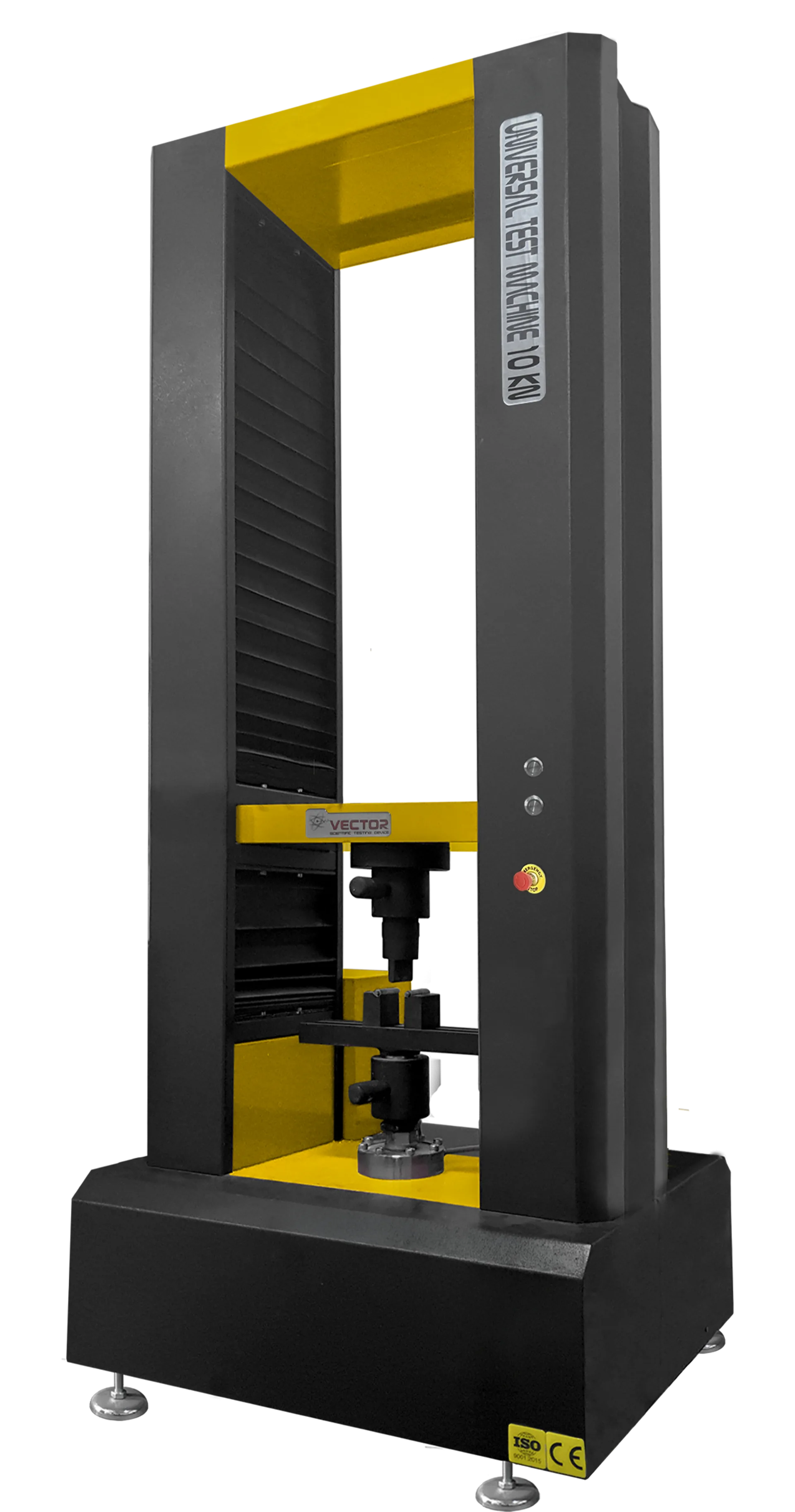
Vector Tesla Series dual-column floor-standing universal testing machine for industrial QA and R&D at 5–50 kN — ASTM E4 / ISO 7500-1 Class 0.5.
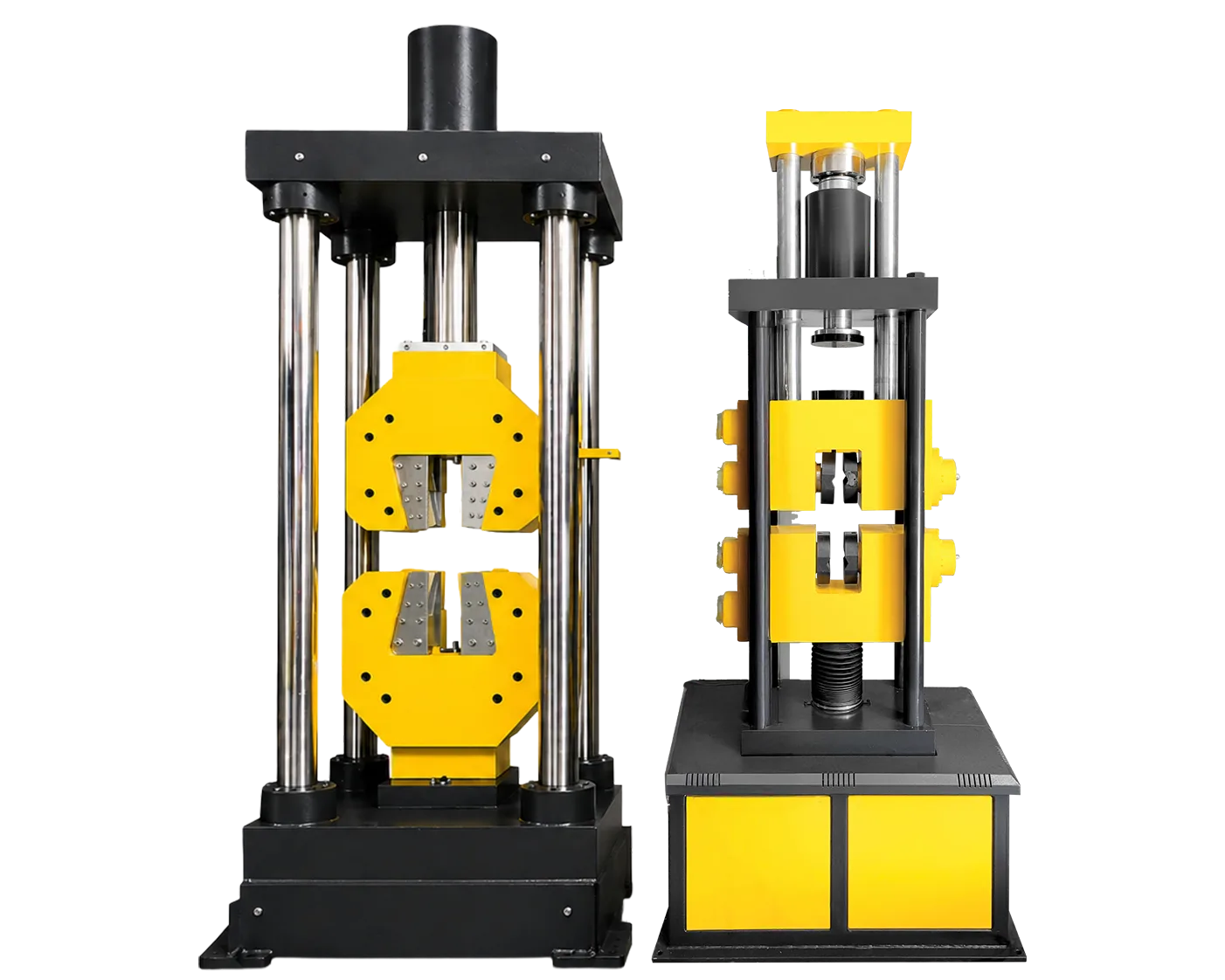
Vector Tesla Series VTR-50 servo-hydraulic UTM — 300 to 5000 kN for tensile, compression and flexural testing on metals, concrete and structural composites.
Compute yield strength Rp, tensile strength Rm, elongation A, and optional reduction of area Z from force and geometry inputs.
Open calculator →Ultimate Tensile Strength
Maximum engineering stress σUTS = Fmax/A0 reached in a monotonic tensile test, also called tensile strength Rm in ISO metals vocabulary; necking causes true stress to exceed engineering stress afterward.
Stress–Strain Curve
The graph of stress versus strain in a tensile or compression test; engineering curves use original area A0, while true curves use instantaneous area and reveal continued hardening after necking.