



Video extensometer
Vector VTR-90-0010
Video extensometer system — non-contact strain and displacement measurement for universal testing machines
Full-field DIC, six-camera auto-view optics, and virtual strain gauges—sub-micron resolution without touching the specimen.
System overview
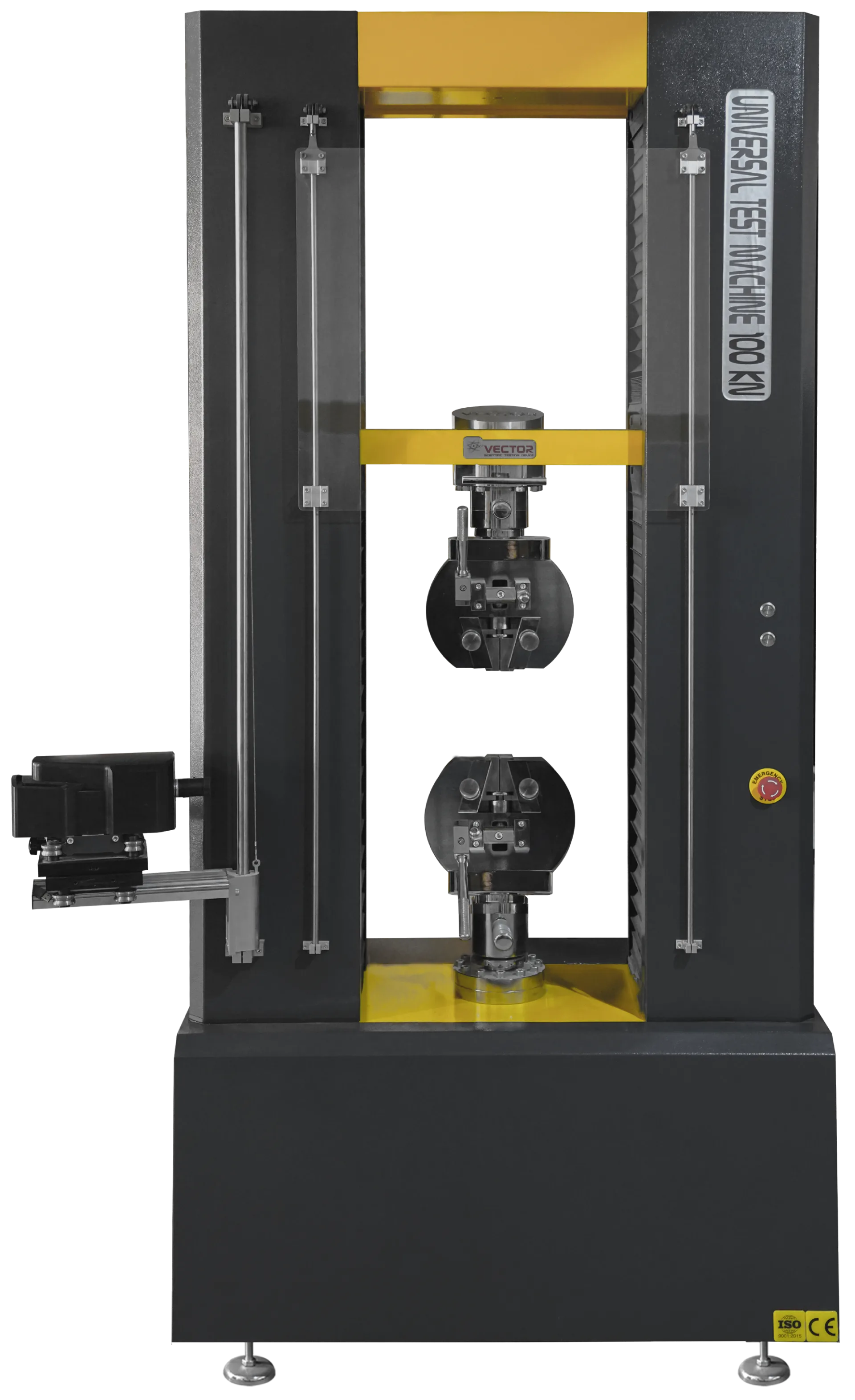
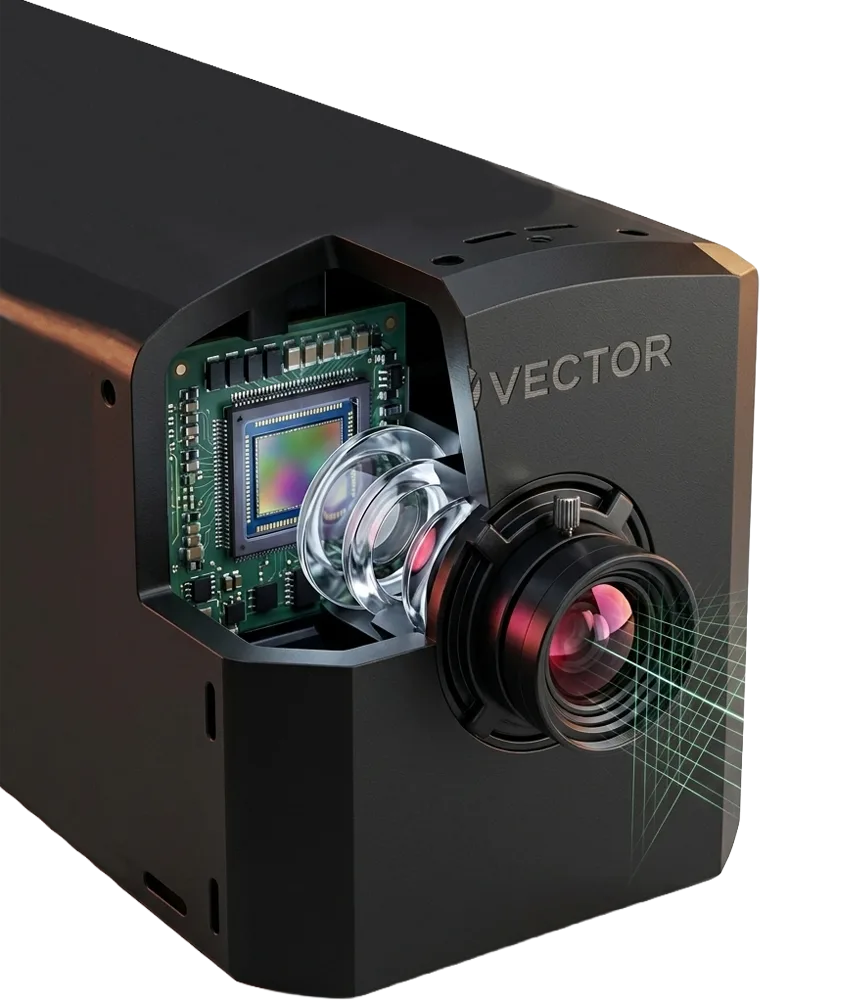
The Vector VTR-90-0010 Video Extensometer System is a non-contact optical measurement solution for precise strain and displacement in materials testing. It is designed to work with universal testing machines (UTMs), combining digital image correlation (DIC), a six-camera auto-view vision system (EX6), and pattern recognition to deliver full-field strain maps, virtual strain gauges, and sub-micron resolution—without mechanical contact to the specimen.
Where clip-on or mechanical extensometers average strain over a fixed gauge length and can disturb delicate samples, the video extensometer captures the deformation field across the visible gauge region in real time. That makes it especially valuable for soft, coated, or fragile materials. The system is aligned with EN ISO 9513 Class 1 accuracy and is supplied with a dedicated PC and pre-installed software for repeatable, audit-friendly workflows.
Why non-contact video extensometry?
Contact extensometers remain standard tools, but video extensometry removes several structural limits of touch-based strain channels:
Single gauge vs. the full field
Traditional extensometers report an average strain between two attachment points. They do not resolve strain localisation, necking onset, or width-wise gradients. Video extensometry measures how deformation evolves across the entire visible gauge area.
Strain maps, not single traces
Contact devices cannot reconstruct full-field axial, transverse, and shear strain on the specimen surface. The VTR-90-0010 outputs tensor-level maps so you can see how strain propagates—not just a single-channel trace.
No knives on the specimen
Clip-on knives, bonded gauges, and similar sensors interact with the surface. After cracking at a gauge location, a bonded gauge may fail while the test continues. A video system keeps tracking through crack initiation and growth without sensor loss.
How it works — digital image correlation (DIC)
The VTR-90-0010 compares images of the specimen surface before and during loading. A speckle or natural texture pattern acts like a fingerprint for small surface patches so each region can be tracked as it moves.
The EX6 auto-view system acquires high-resolution image sequences through the test. The DIC engine tracks every tracked patch frame by frame and builds full-field displacement and strain maps in real time. Virtual strain gauges can be placed anywhere in the field of view—in software before, during, or after the run—without attaching physical hardware.
You can re-analyse archived sequences with different virtual gauge positions, lengths, or strain components after the test is finished—something a contact extensometer cannot replicate once the hardware is fixed.
Key features
The VTR-90-0010 captures multiple strain and displacement components across the specimen surface at once. Axial and transverse strains support Poisson's ratio and plastic strain ratio (r-value); shear and principal strains support biaxial and complex states—outputs that a single-axis contact gauge cannot supply alone.
Real-time virtual strain gauges
Place one or many virtual gauges between any two points in the field of view. Positions are stored with the dataset and can be adjusted in post-processing without re-running the physical test.
Sub-micron displacement resolution
Less than 1 micrometre displacement resolution supports early elastic response on stiff metals, ceramics, and high-modulus composites—regions where knife-edge slip or surface damage can bias contact devices.
EN ISO 9513 Class 1
Factory calibration and certification to EN ISO 9513 Class 1 using traceable samples. This supports modulus reporting under ISO 527 and JIS K 7161 where Class 1 extensometry is required for Young's modulus of plastics and similar cases.
Autocalibration
Automatic calibration adjustment on certified samples reduces manual steps and operator-to-operator variability so the vision chain is verified before critical test sessions.
Strain at failure
The software records strain at the instant of fracture—useful for brittle materials, high-strength metals, and composites where failure is rapid and localised.
Six-camera EX6 auto-view
Six camera units maintain coverage as the specimen elongates, supporting specimen lengths from 50 mm up to 700 mm with consistent illumination across the field of view.
Dual illumination
Multiple bright-field broadband illumination (420–780 nm) plus a 632 nm laser source stabilise contrast against ambient light changes, shadows, and difficult surface finishes.
Universal UTM compatibility
Attach-and-go mounting with USB 2.0/3.0 communication—no proprietary interface cards required. Works with Vector and third-party UTMs for straightforward retrofits.
Synchronised export
Time, test time, force, machine displacement, and strain field data stay aligned with UTM channels and export as .dat, .csv, and .xls for overlay with force–displacement curves, LIMS, or custom pipelines.
Technical specifications
| Parameter | Specification |
|---|---|
| Product code | VTR-90-0010 |
| Vision system | EX6 auto-view — 6 camera units |
| Sample width | 5–50 mm |
| Sample length | 50–700 mm |
| Resolution | < 1 μm |
| Accuracy standard | EN ISO 9513 Class 1 |
| Calibration | Autocalibration with certified calibration samples |
| Illumination | Multiple bright field (420–780 nm) + laser (632 nm) |
| Communication | USB 2.0 / 3.0 |
| Power requirements | 100–240 V, 50/60 Hz, 10 A max (fused) |
| Operating temperature | 5 °C – 50 °C |
| Software language | English (additional languages available on request) |
| Included hardware | Dedicated PC with pre-installed software |
| UTM compatibility | Universal — electromechanical and hydraulic frames |
| Data export formats | .dat, .csv, .xls |
Application areas
Typical disciplines where full-field, non-contact strain measurement replaces or augments contact extensometry:
| Industry / application | Benefit of non-contact measurement |
|---|---|
| Metals and alloys | Resolve yield, Lüders bands, and necking without knife-edge slip artefacts. |
| Polymers and plastics | Measure modulus and elongation at break on soft specimens without contact-induced stress concentrations. |
| Composites and laminates | Map shear and principal strains to observe delamination and anisotropic response. |
| Biomedical and soft tissues | Preserve hydrogels, membranes, and tissue samples that would be disturbed by clips. |
| Textiles and nonwovens | Track strain across woven or knitted structures without sensor interference. |
| Thin films and foils | Capture low-elongation elastic response on very stiff, delicate foils. |
| Adhesives and joints | Visualise deformation along the bond line and adjacent adherends simultaneously. |
| R&D and characterisation | Extract Poisson's ratio, r-value, shear modulus, and biaxial strain from one dataset. |
| Education and training | Colour-mapped strain fields make deformation mechanisms easy to teach. |
Software capabilities
Live, pre-, and post-processing
Stream strain fields during the test, adjust analysis parameters in session, and re-run DIC on stored images with different gauges or filters after the fact.
Password-protected records
Project files, calibration records, and exports can be stored with access control for regulated laboratories.
Operator-focused UI
Guided setup for camera alignment, virtual gauge placement, and reporting reduces training time while keeping measurement tasks repeatable.
Frequently asked questions
Does the VTR-90-0010 replace my clip-on extensometer?
Many labs use both: clip-on devices remain convenient for routine metals work, while the video system covers full-field studies, soft materials, and tests where contact must be avoided.
Which UTMs are supported?
The system communicates over USB and mounts adjacent to the test zone; it is intended to integrate with any UTM brand that exposes standard data export and trigger lines where required.
How is accuracy verified?
The hardware and software are calibrated to EN ISO 9513 Class 1 using certified samples. Periodic verification follows the same traceable samples used during factory calibration.
Summary
The Vector VTR-90-0010 is a DIC-based, full-field strain platform that delivers sub-micron resolution, Class 1 extensometer accuracy, and universal UTM compatibility in a single attach-and-go package for laboratories that need more than a single strain trace.