



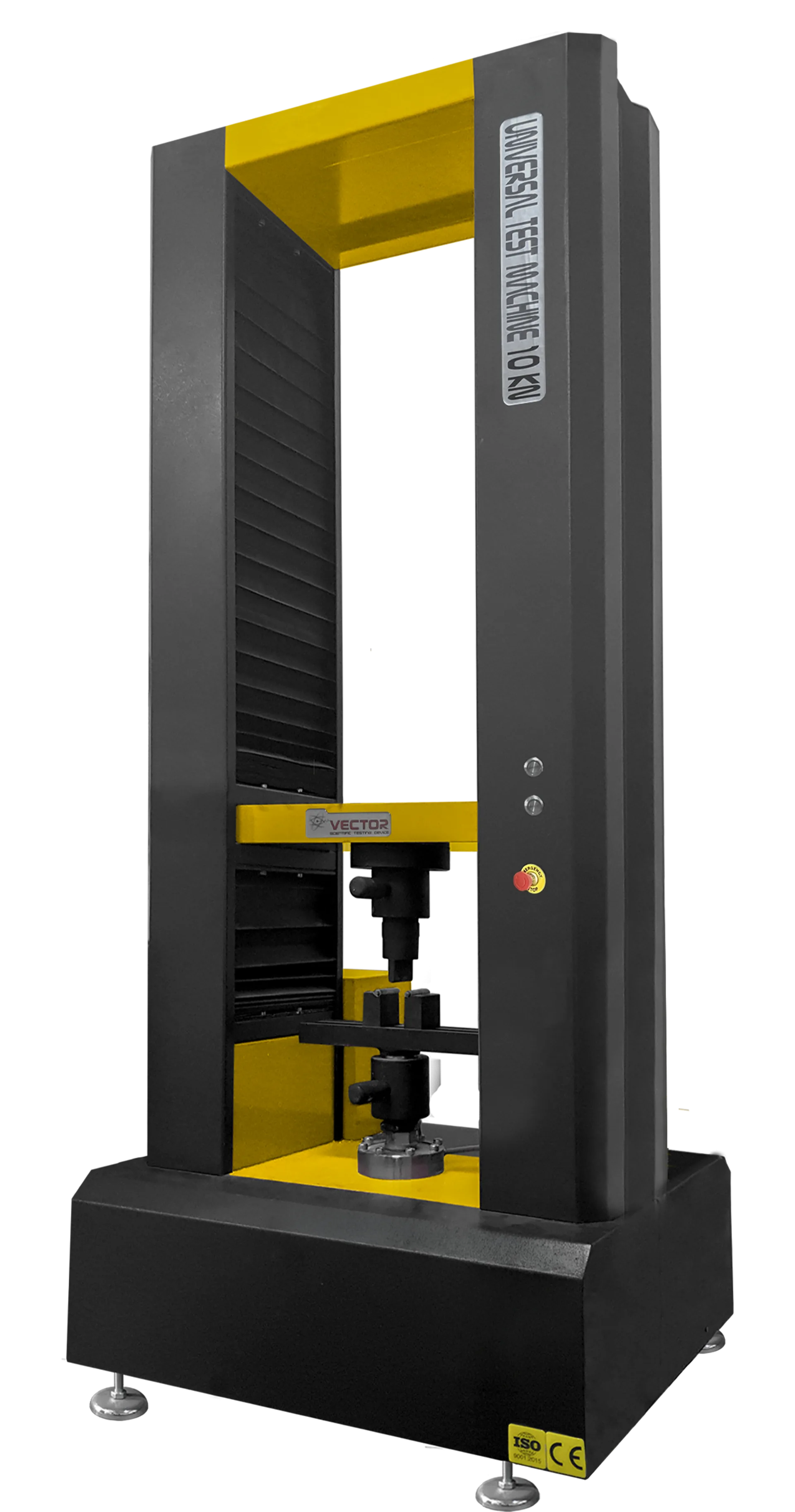
Universal Testing Machine (5–50 kN)
Vector Tesla Series dual-column floor-standing universal testing machine for industrial QA and R&D at 5–50 kN — ASTM E4 / ISO 7500-1 Class 0.5.
- iso-7500-1
- astm-e4
- +3 more
View details →
Strain-measuring device attached to a specimen gauge section so tensile machines report elongation and modulus independent of crosshead displacement and grip compliance.
Strain-measuring device attached to a specimen gauge section so tensile machines report elongation and modulus independent of crosshead displacement and grip compliance.
Formula
ε = ΔL / L0
ΔL is gauge-length change and L0 is initial gauge length. Contact, non-contact, and video extensometers map displacement to engineering or axial strain.
An extensometer measures strain in the gauge length rather than total crosshead travel. That separation is essential for accurate Young’s modulus, yield/proof stress, and elongation at break on metals and polymers.
Clip-on, axial, or video extensometers are mounted per manufacturer guidance. Strain rate control (ISO 6892-1 Method A) uses extensometer feedback to regulate loading speed.
Classify extensometer gauge length and calibration traceability. Report whether strain is engineering or axial, and whether the device was removed before fracture per method limits.
Knife-edge slip, gauge length outside the parallel section, and leaving a long gauge extensometer on through necking can invalidate high-strain readings.
Vector Tesla Series dual-column floor-standing universal testing machine for industrial QA and R&D at 5–50 kN — ASTM E4 / ISO 7500-1 Class 0.5.
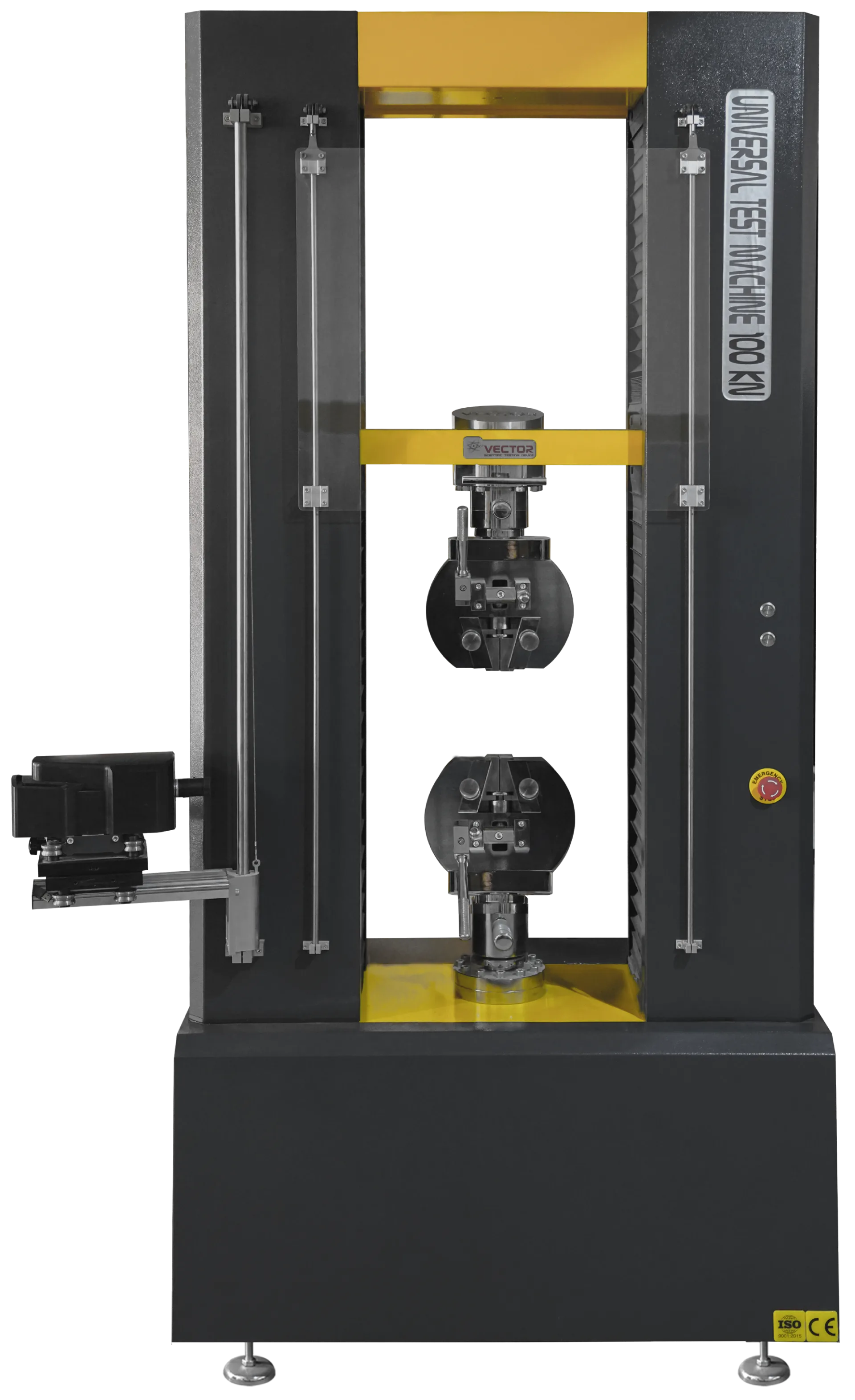
Vector Tesla Series heavy-duty dual-column UTM for tensile, compression, flexure and shear up to 300 kN — ASTM E4 / ISO 7500-1 Class 0.5 accuracy.
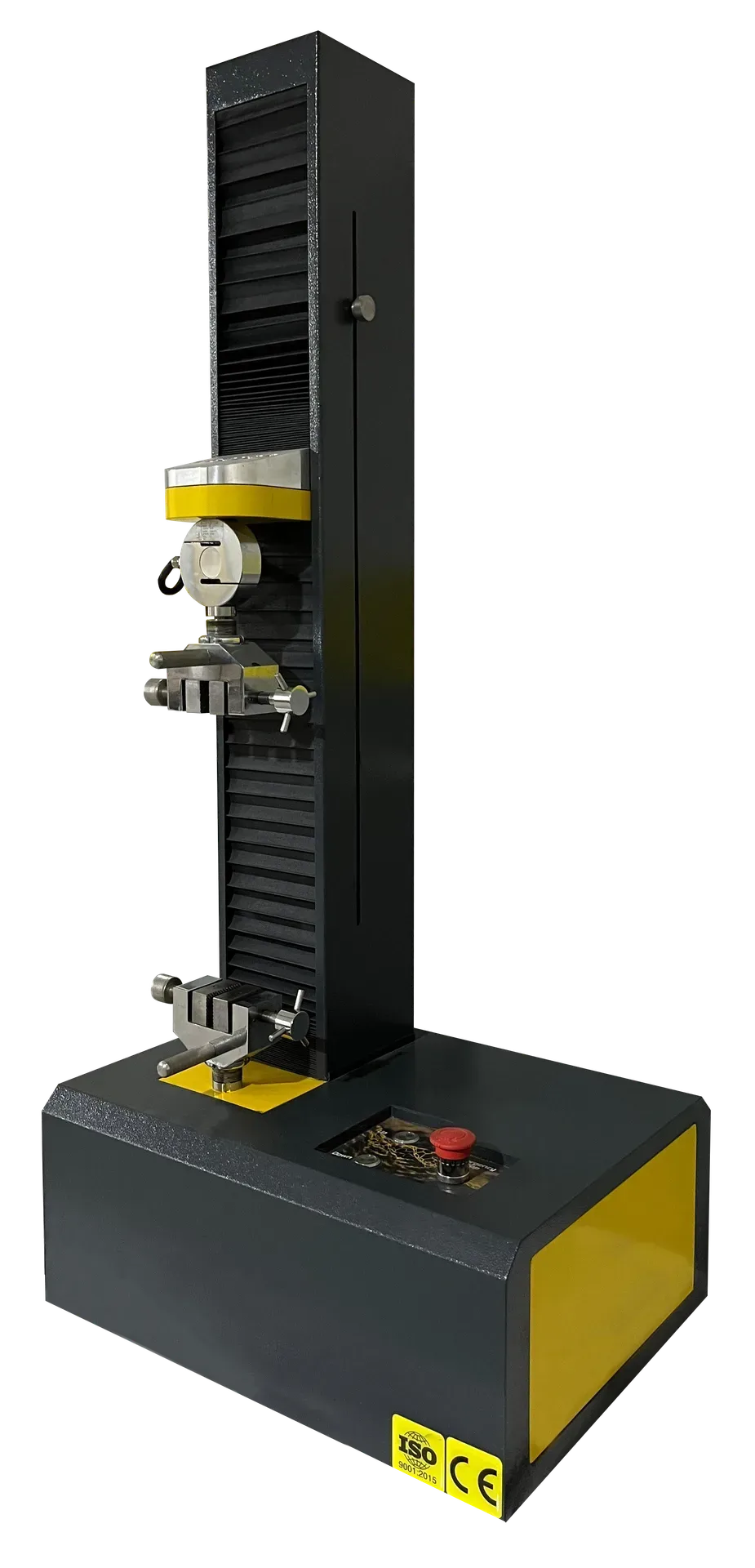
Vector Tesla Series single-column benchtop universal testing machine for high-precision, low-force material testing — ASTM E4 / ISO 7500-1 Class 0.5.
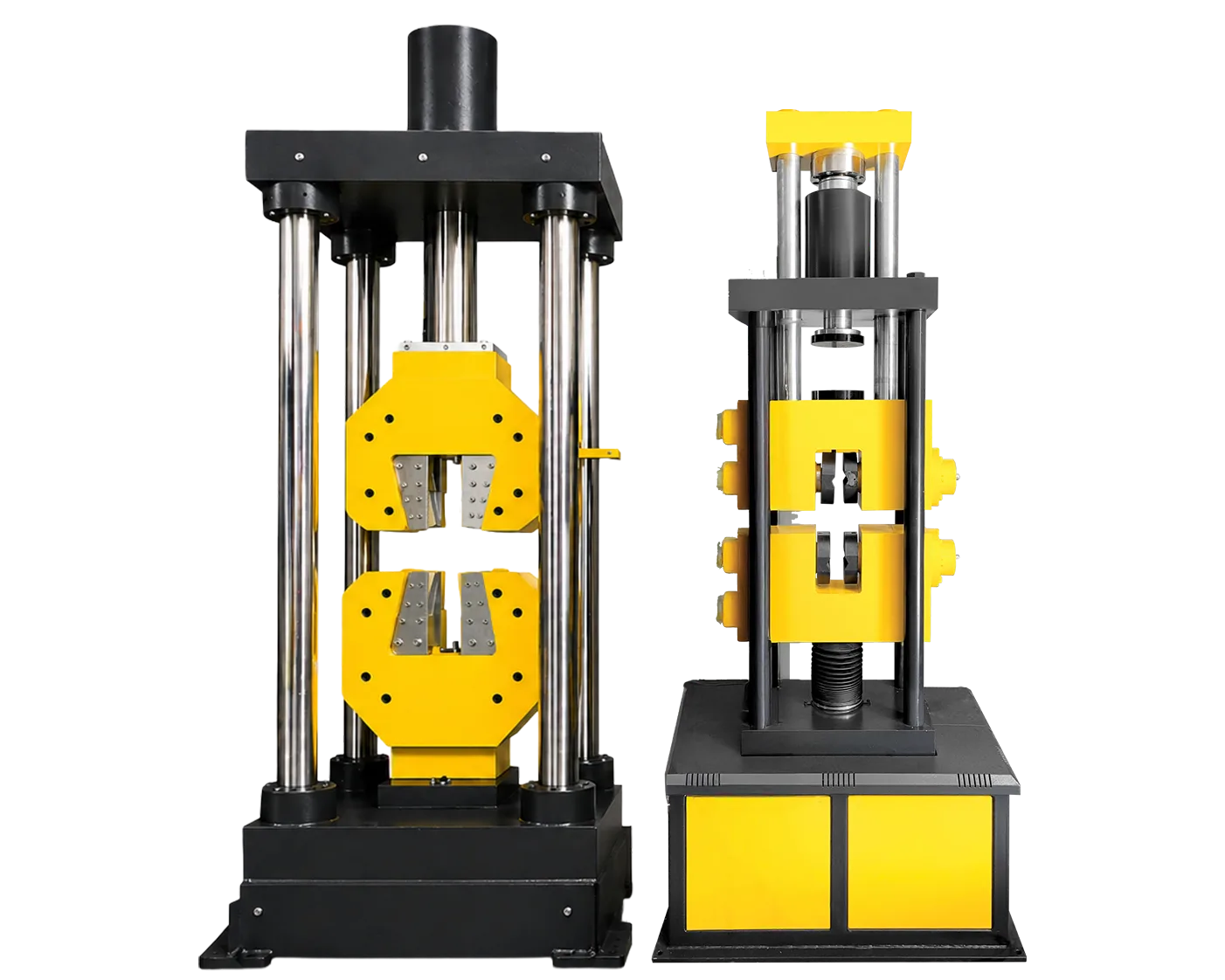
Vector Tesla Series VTR-50 servo-hydraulic UTM — 300 to 5000 kN for tensile, compression and flexural testing on metals, concrete and structural composites.
Compute yield strength Rp, tensile strength Rm, elongation A, and optional reduction of area Z from force and geometry inputs.
Open calculator →Stress–Strain Curve
The graph of stress versus strain in a tensile or compression test; engineering curves use original area A0, while true curves use instantaneous area and reveal continued hardening after necking.
Young's Modulus
The proportionality constant E between uniaxial stress and elastic strain in Hooke's regime (σ = Eε); slope of the initial linear region on a stress–strain curve for isotropic materials.
Yield Strength
The stress at which a material begins to deform plastically under monotonic loading; metals are often reported as Rp0.2 using the 0.2% plastic strain offset on the engineering stress–strain curve.