



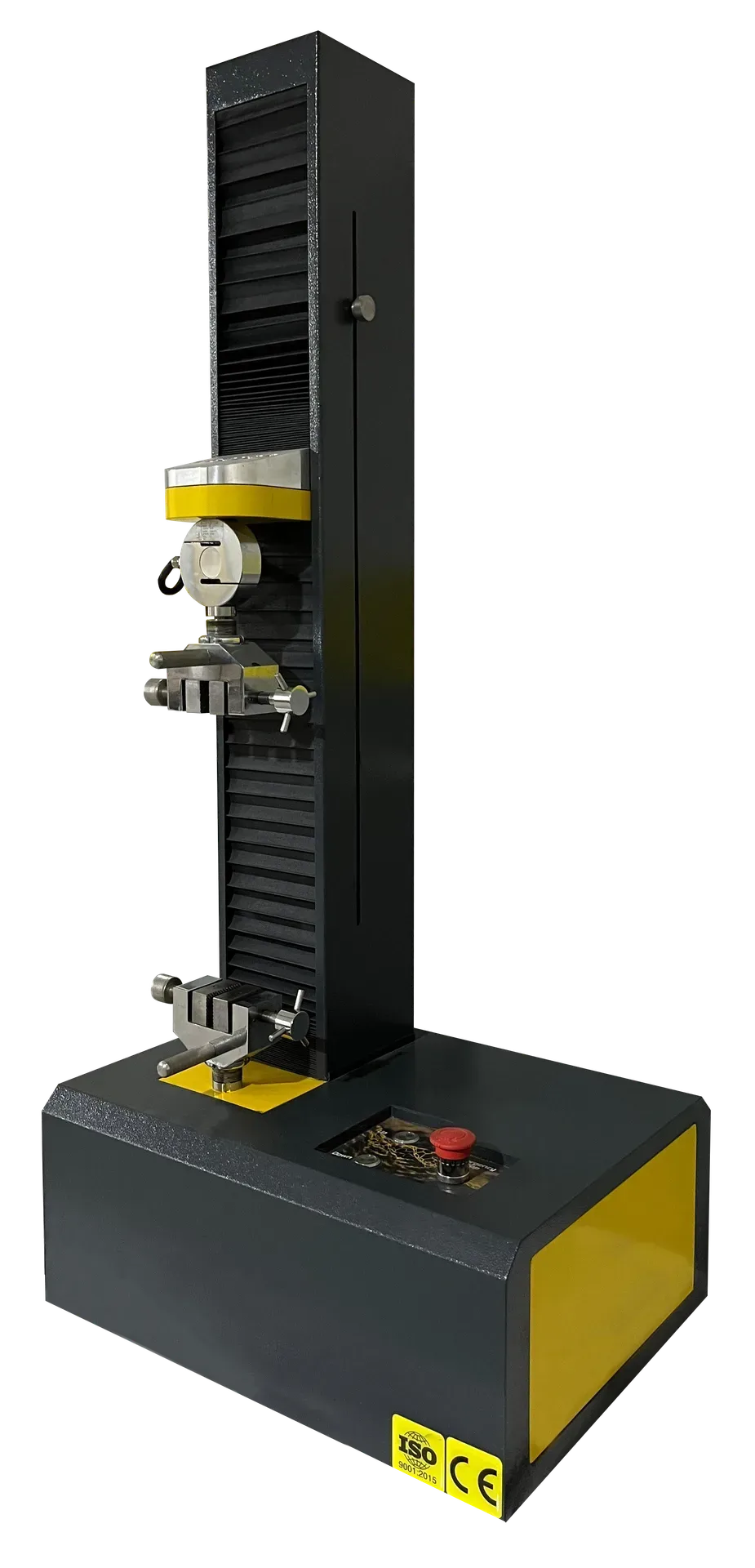
Benchtop Universal Testing Machine (0.5–2 kN)
Vector Tesla Series single-column benchtop universal testing machine for high-precision, low-force material testing — ASTM E4 / ISO 7500-1 Class 0.5.
- iso-7500-1
- astm-e4
- +3 more
View details →
The proportionality constant E between uniaxial stress and elastic strain in Hooke's regime (σ = Eε); slope of the initial linear region on a stress–strain curve for isotropic materials.
The proportionality constant E between uniaxial stress and elastic strain in Hooke's regime (σ = Eε); slope of the initial linear region on a stress–strain curve for isotropic materials.
Formula
E = σ / ε (elastic, small strain)
In the linear elastic range, axial stress σ and elastic strain ε are related by Hooke’s law. E is extracted from the slope of the stress–strain curve using extensometry; machine compliance corrections matter at small strains.
Young’s modulus (E) characterizes stiffness in the elastic regime: how much stress is required to produce a small recoverable strain. For isotropic homogeneous solids under uniaxial tension or compression, σ = Eε holds until proportional limit or yield supersedes linearity.
E is determined from the slope of the stress–strain curve in the initial linear region. High-precision measurement requires high-resolution extensometers or non-contact strain measurement and subtraction of machine and grip compliance, which otherwise underestimate E.
For polycrystalline metals, E is relatively insensitive to microstructure compared to yield strength, but texture in rolled sheet can produce apparent directional moduli if off-axis specimens are tested. Composites and polymers exhibit viscoelasticity; “modulus” then depends on time, temperature, and strain rate.
Designers use E with second moments of area to estimate deflections, resonant frequencies, and buckling loads. It should not be confused with tangent modulus or secant modulus used beyond yield in nonlinear analysis.
Vector Tesla Series single-column benchtop universal testing machine for high-precision, low-force material testing — ASTM E4 / ISO 7500-1 Class 0.5.
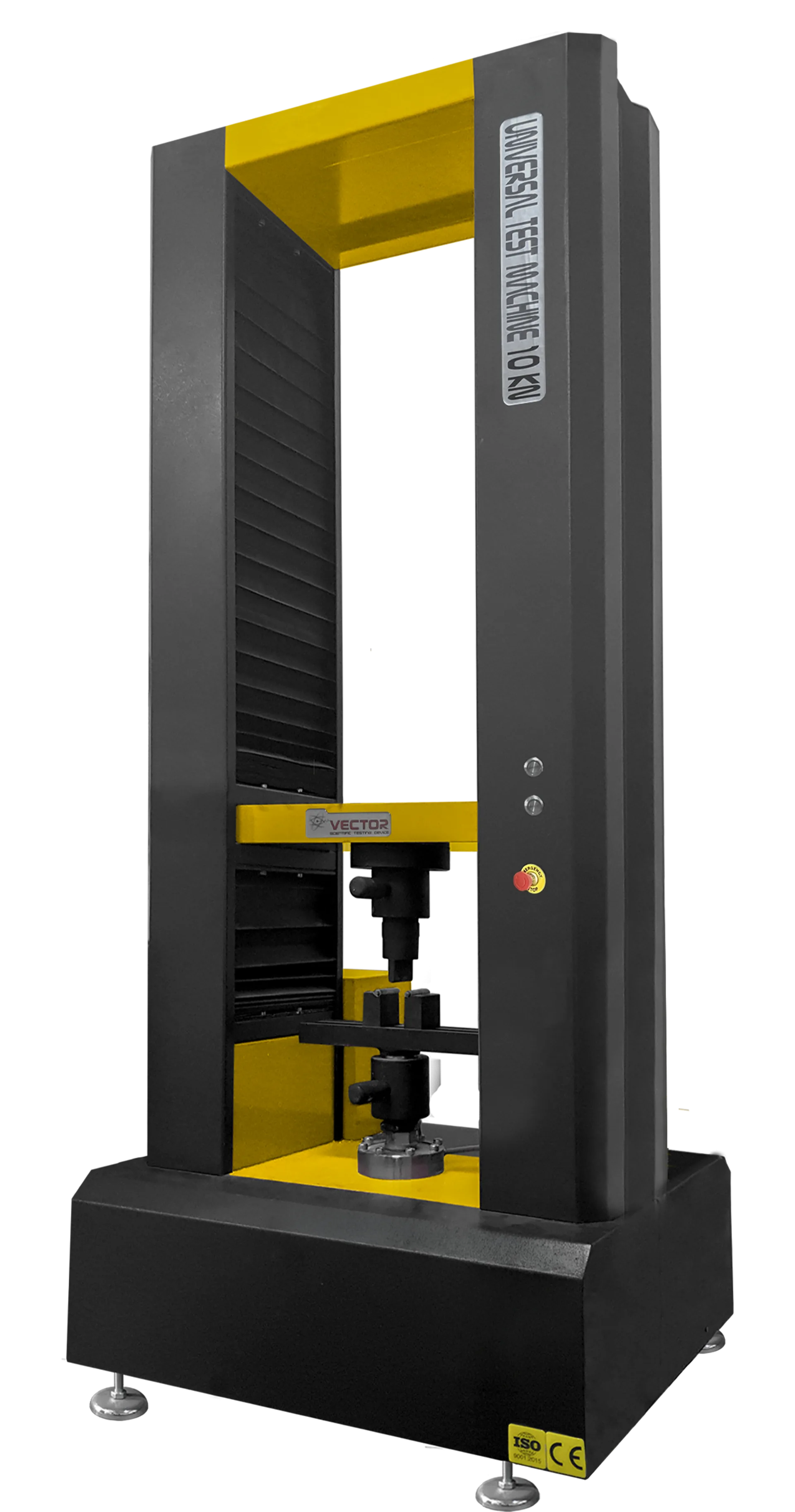
Vector Tesla Series dual-column floor-standing universal testing machine for industrial QA and R&D at 5–50 kN — ASTM E4 / ISO 7500-1 Class 0.5.
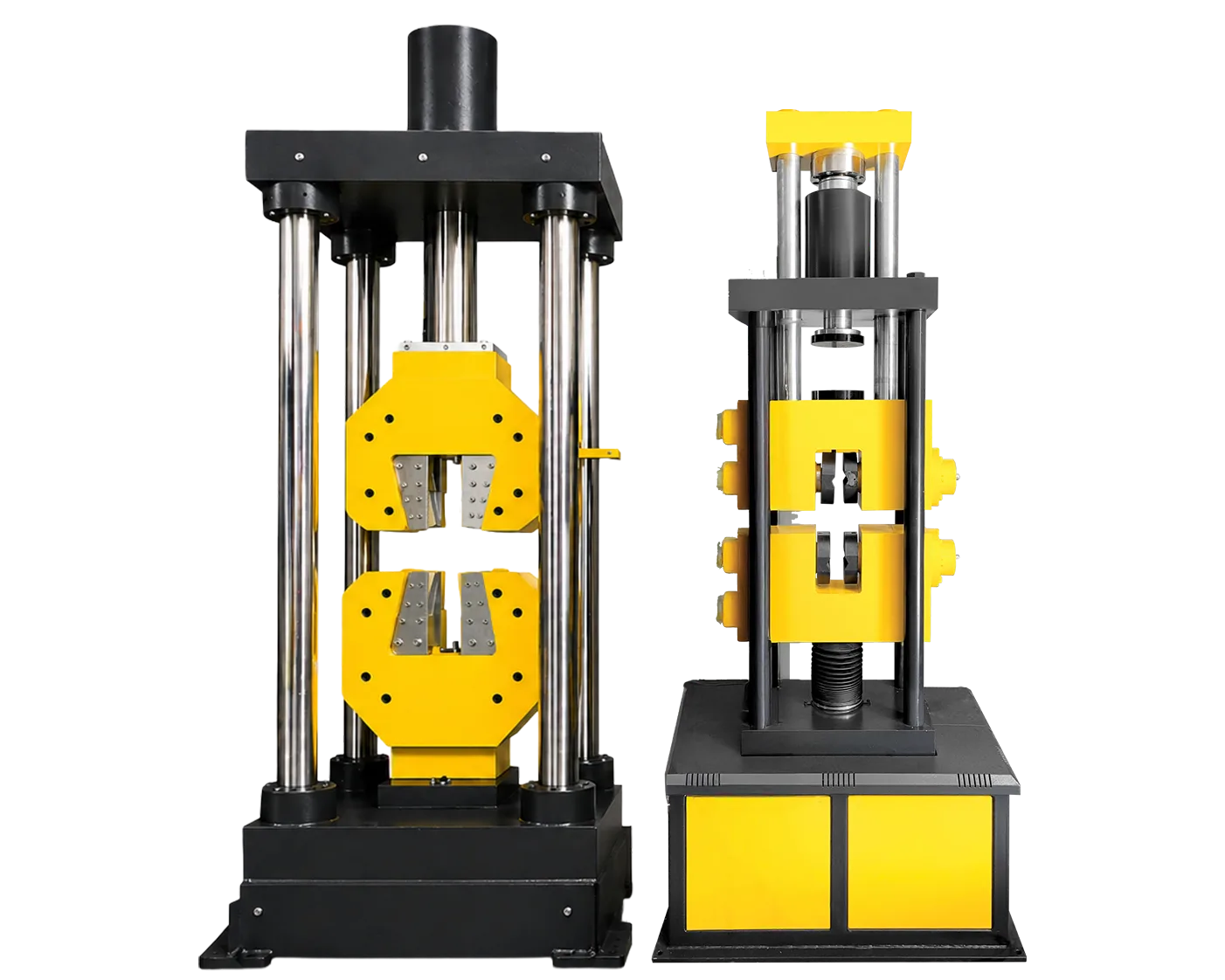
Vector Tesla Series VTR-50 servo-hydraulic UTM — 300 to 5000 kN for tensile, compression and flexural testing on metals, concrete and structural composites.
Compute yield strength Rp, tensile strength Rm, elongation A, and optional reduction of area Z from force and geometry inputs.
Open calculator →Stress–Strain Curve
The graph of stress versus strain in a tensile or compression test; engineering curves use original area A0, while true curves use instantaneous area and reveal continued hardening after necking.
Yield Strength
The stress at which a material begins to deform plastically under monotonic loading; metals are often reported as Rp0.2 using the 0.2% plastic strain offset on the engineering stress–strain curve.