



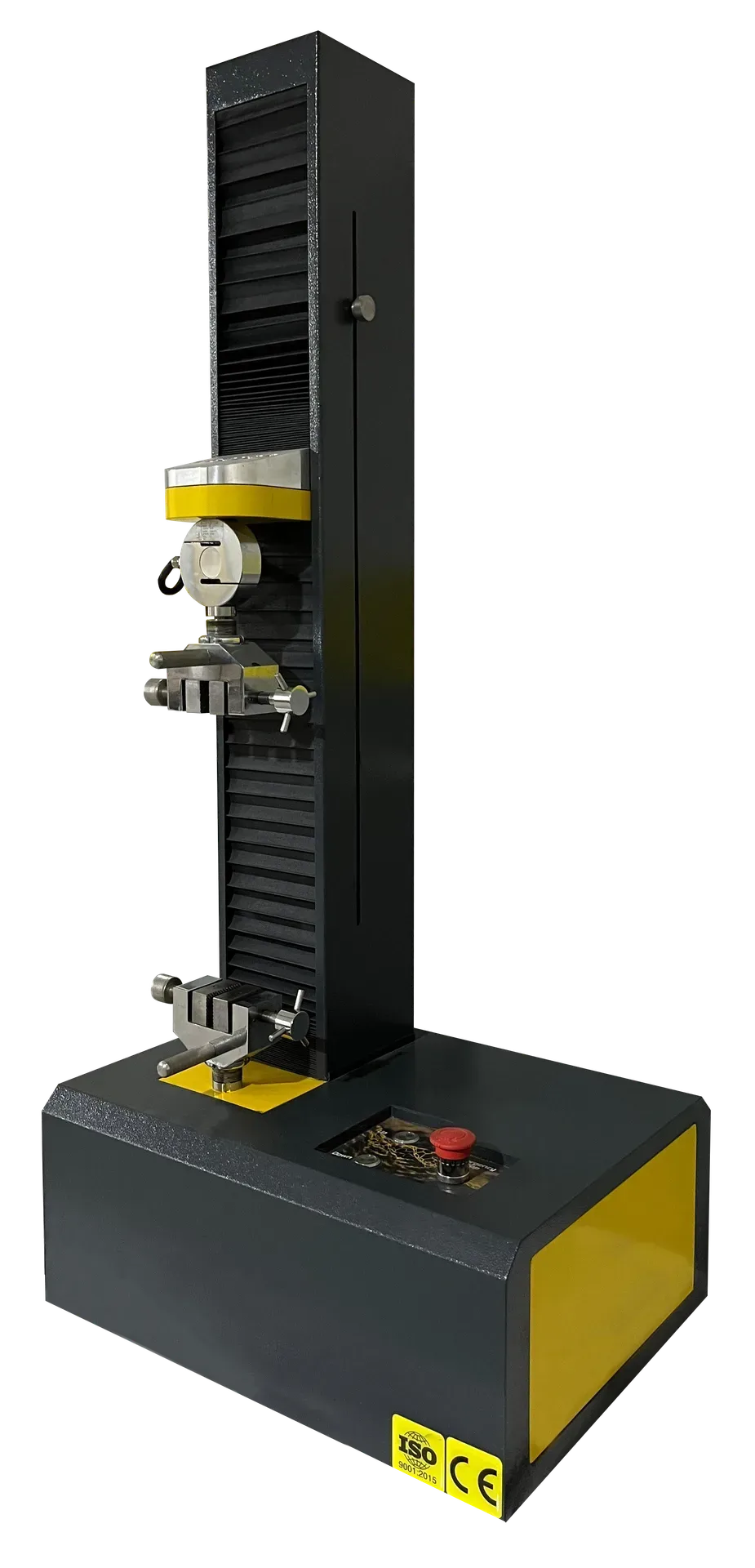
Benchtop Universal Testing Machine (0.5–2 kN)
Vector Tesla Series single-column benchtop universal testing machine for high-precision, low-force material testing — ASTM E4 / ISO 7500-1 Class 0.5.
- iso-7500-1
- astm-e4
- +3 more
View details →
The stress at which a material begins to deform plastically under monotonic loading; metals are often reported as Rp0.2 using the 0.2% plastic strain offset on the engineering stress–strain curve.
The stress at which a material begins to deform plastically under monotonic loading; metals are often reported as Rp0.2 using the 0.2% plastic strain offset on the engineering stress–strain curve.
Formula
Rp0.2 from σ at εp = 0.2%
Engineering stress σ = F/A0 with original area A0; plastic strain εp is measured from the stress–strain curve. The offset line is parallel to the elastic slope E, intersecting εp = 0.002 (0.2%) to define Rp0.2 per ISO 6892-1 / ASTM E8.
Yield strength separates elastic deformation (recoverable on unloading) from plastic flow (permanent strain). In low-carbon steels, a distinct upper and lower yield point may appear due to dislocation unlocking (Lüders bands); other alloys show gradual yielding without a sharp knee.
When a sharp yield is absent, international standards specify proof strength such as Rp0.2: a line parallel to the elastic portion, offset by 0.2% plastic strain, intersects the curve to define the proof stress. Rp0.1 and other offsets are used for spring steels or aerospace alloys requiring tighter elastic limits.
Accurate yield reporting requires extensometry aligned with the gauge section, correction for machine compliance at low strains, and controlled strain rates because many metals are strain-rate sensitive. Misalignment or grip slippage exaggerates apparent yielding.
Yield strength governs elastic design limits for static components, but designers must also check buckling, fatigue, and creep depending on service temperature and load history. For anisotropic sheet metals, tensile yield may differ with rolling direction; multiple orientations should be tested.
Vector Tesla Series single-column benchtop universal testing machine for high-precision, low-force material testing — ASTM E4 / ISO 7500-1 Class 0.5.
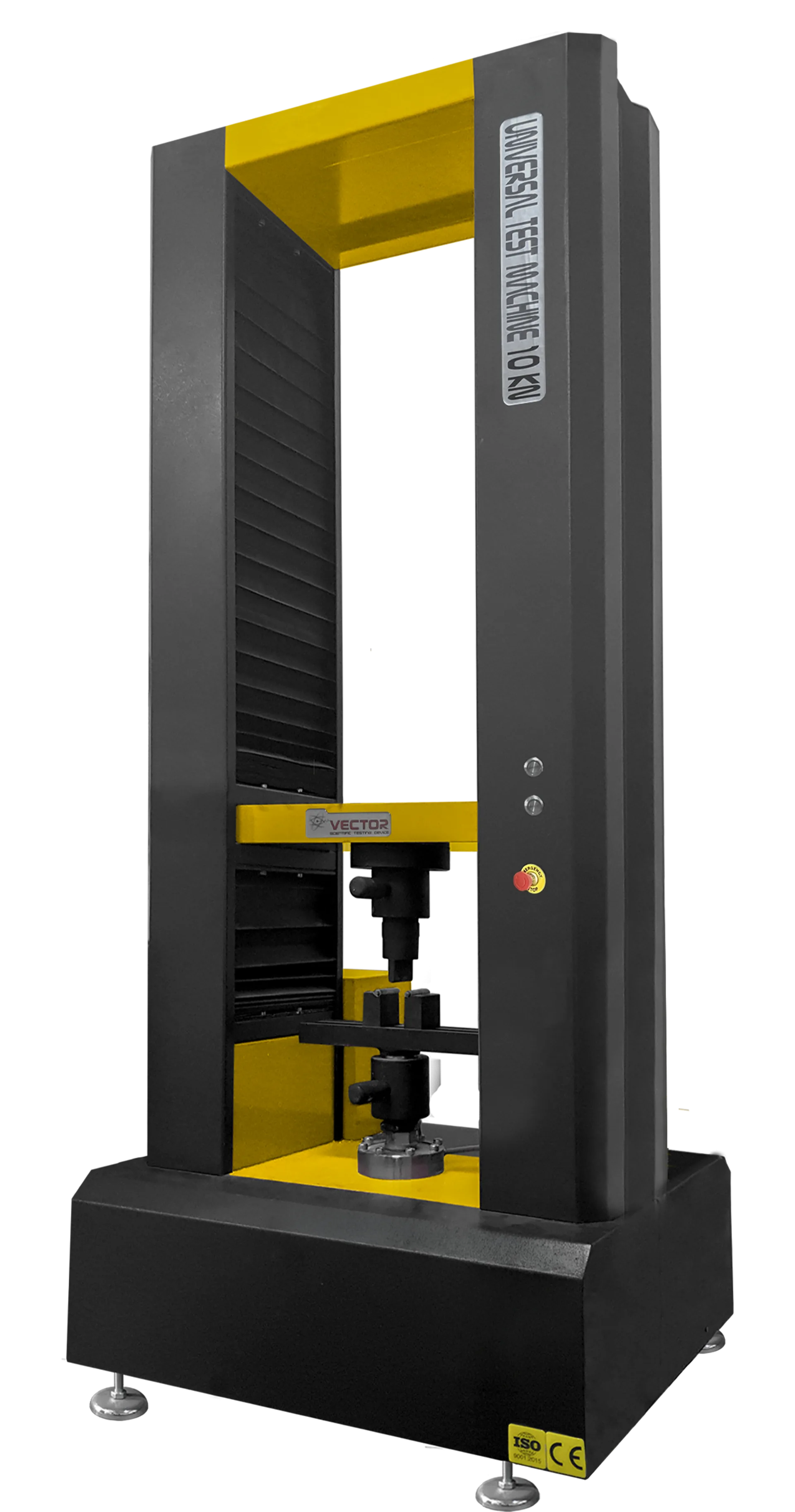
Vector Tesla Series dual-column floor-standing universal testing machine for industrial QA and R&D at 5–50 kN — ASTM E4 / ISO 7500-1 Class 0.5.
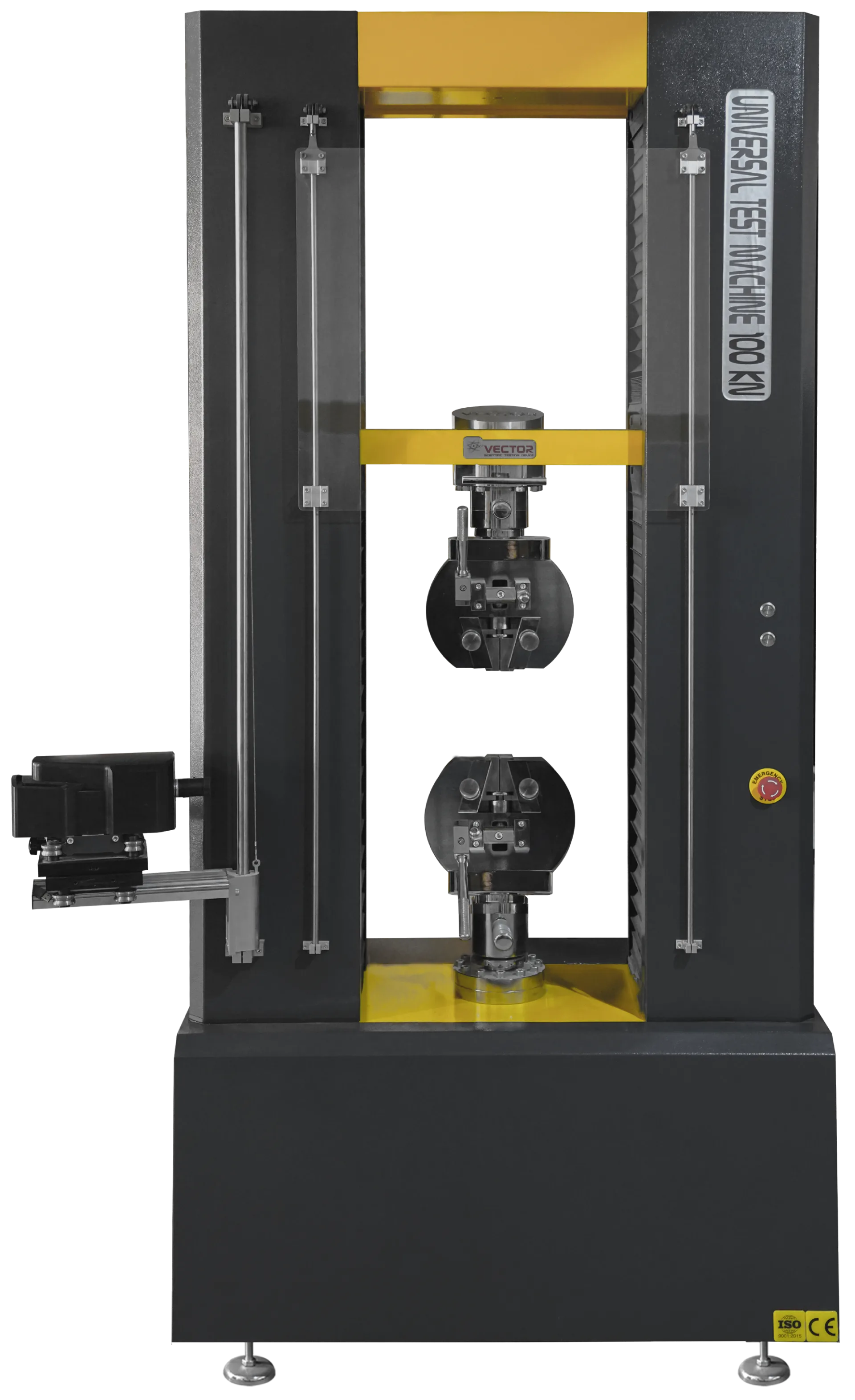
Vector Tesla Series heavy-duty dual-column UTM for tensile, compression, flexure and shear up to 300 kN — ASTM E4 / ISO 7500-1 Class 0.5 accuracy.
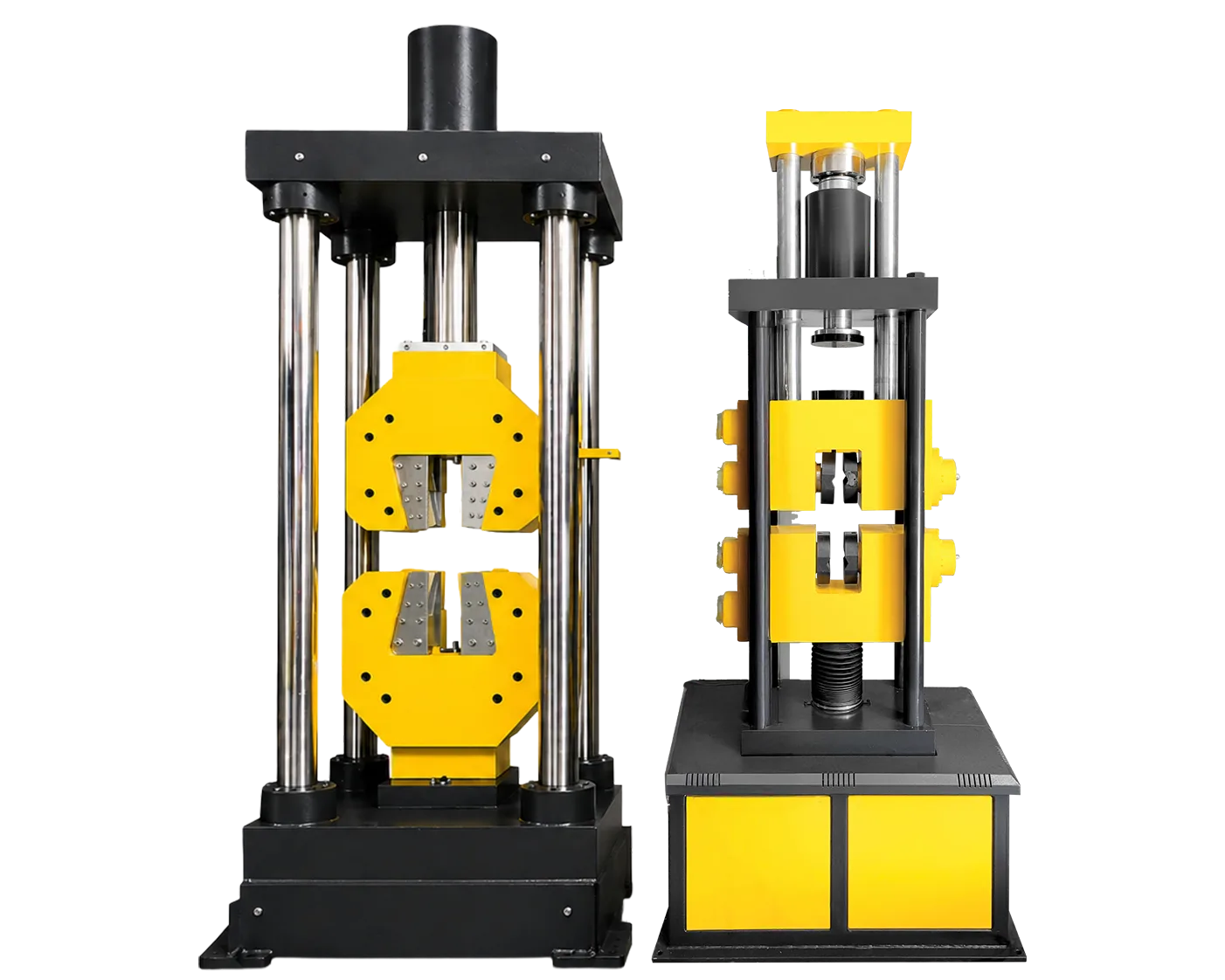
Vector Tesla Series VTR-50 servo-hydraulic UTM — 300 to 5000 kN for tensile, compression and flexural testing on metals, concrete and structural composites.
Compute yield strength Rp, tensile strength Rm, elongation A, and optional reduction of area Z from force and geometry inputs.
Open calculator →Ultimate Tensile Strength
Maximum engineering stress σUTS = Fmax/A0 reached in a monotonic tensile test, also called tensile strength Rm in ISO metals vocabulary; necking causes true stress to exceed engineering stress afterward.
Stress–Strain Curve
The graph of stress versus strain in a tensile or compression test; engineering curves use original area A0, while true curves use instantaneous area and reveal continued hardening after necking.
Young's Modulus
The proportionality constant E between uniaxial stress and elastic strain in Hooke's regime (σ = Eε); slope of the initial linear region on a stress–strain curve for isotropic materials.