



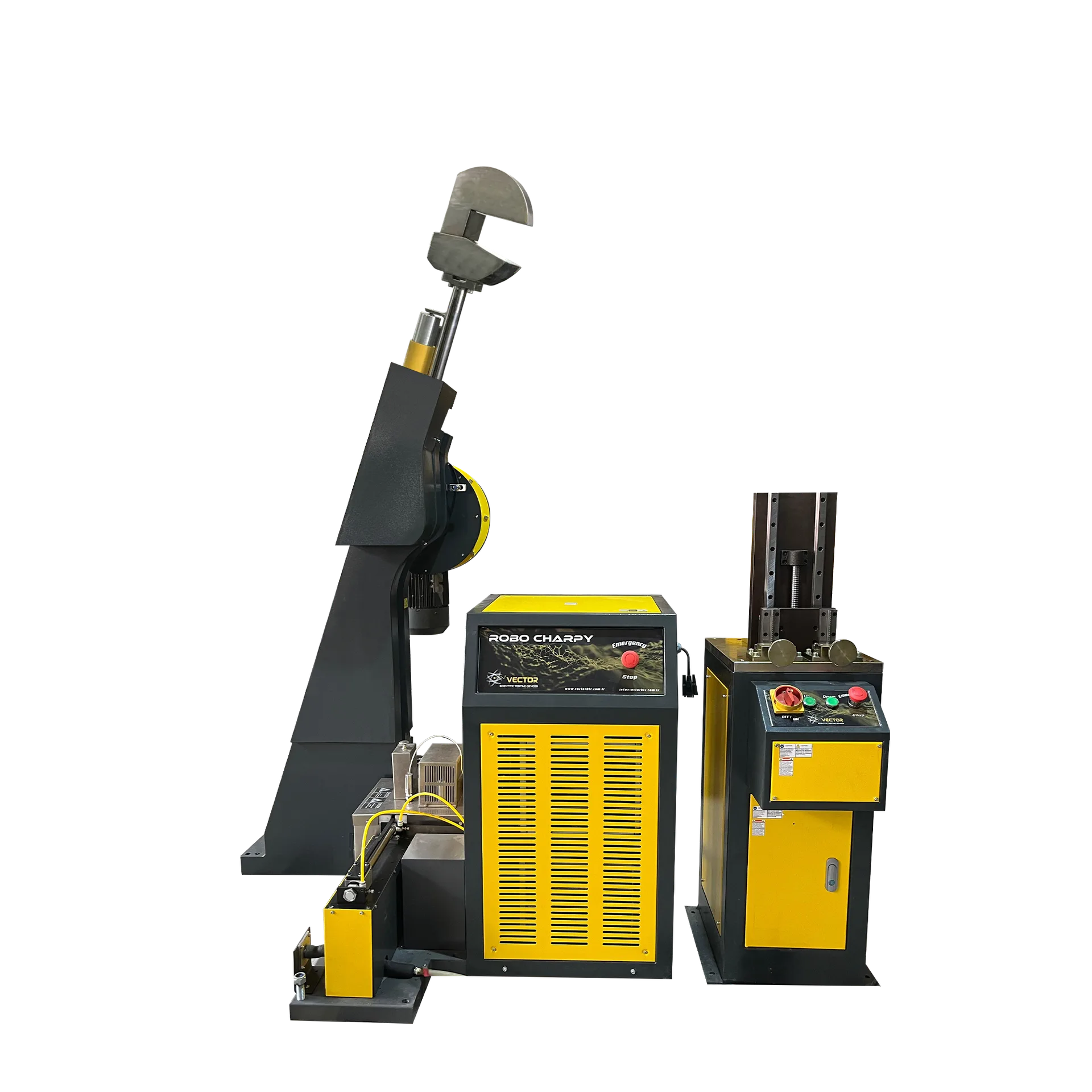
Robo Charpy Impact Testing System
Vector Robo Charpy system for metal notch toughness per ISO 148-1 and ASTM E23 — manual, semi-automatic or robotic lines from 300 J to 750 J with sub-zero option.
- iso-148-1
- astm-e23
- +1 more
View details →
A notched bar is broken by a swinging pendulum striker; absorbed energy KV or KU (joules) characterizes toughness and ductile-to-brittle transition versus temperature.
A notched bar is broken by a swinging pendulum striker; absorbed energy KV or KU (joules) characterizes toughness and ductile-to-brittle transition versus temperature.
Formula
KV = E0 − E1
E0 is initial pendulum energy and E1 is residual energy after fracture; the difference, with friction corrections per ISO 148-1 / ASTM E23, is absorbed energy. Results depend on notch geometry and specimen size.
The Charpy V-notch test is the dominant screening method for steel toughness, including ductile-to-brittle transition in ferritic steels used for pressure vessels and pipelines. A standard notched bar rests on anvils while a pendulum striker impacts the face opposite the notch; the machine measures how much kinetic energy is absorbed in fracture.
Results for full-size 10×10 mm specimens with 2 mm V-notch are reported as KV2; sub-size variants are scaled per standards. Acceptance criteria in project specifications may add shear lip percentage and lateral expansion alongside energy.
Charpy is temperature-sensitive; a transition curve (energy vs temperature) locates the upper shelf, transition region, and lower shelf. Misalignment, blunt strikers, or loose anvils bias energy low or high.
Charpy is not a direct fracture mechanics parameter, but with appropriate correlation studies it can relate to CTOD or KIc for some material classes. It remains essential for batch release and validating welding or heat-treatment procedures.
Vector Robo Charpy system for metal notch toughness per ISO 148-1 and ASTM E23 — manual, semi-automatic or robotic lines from 300 J to 750 J with sub-zero option.
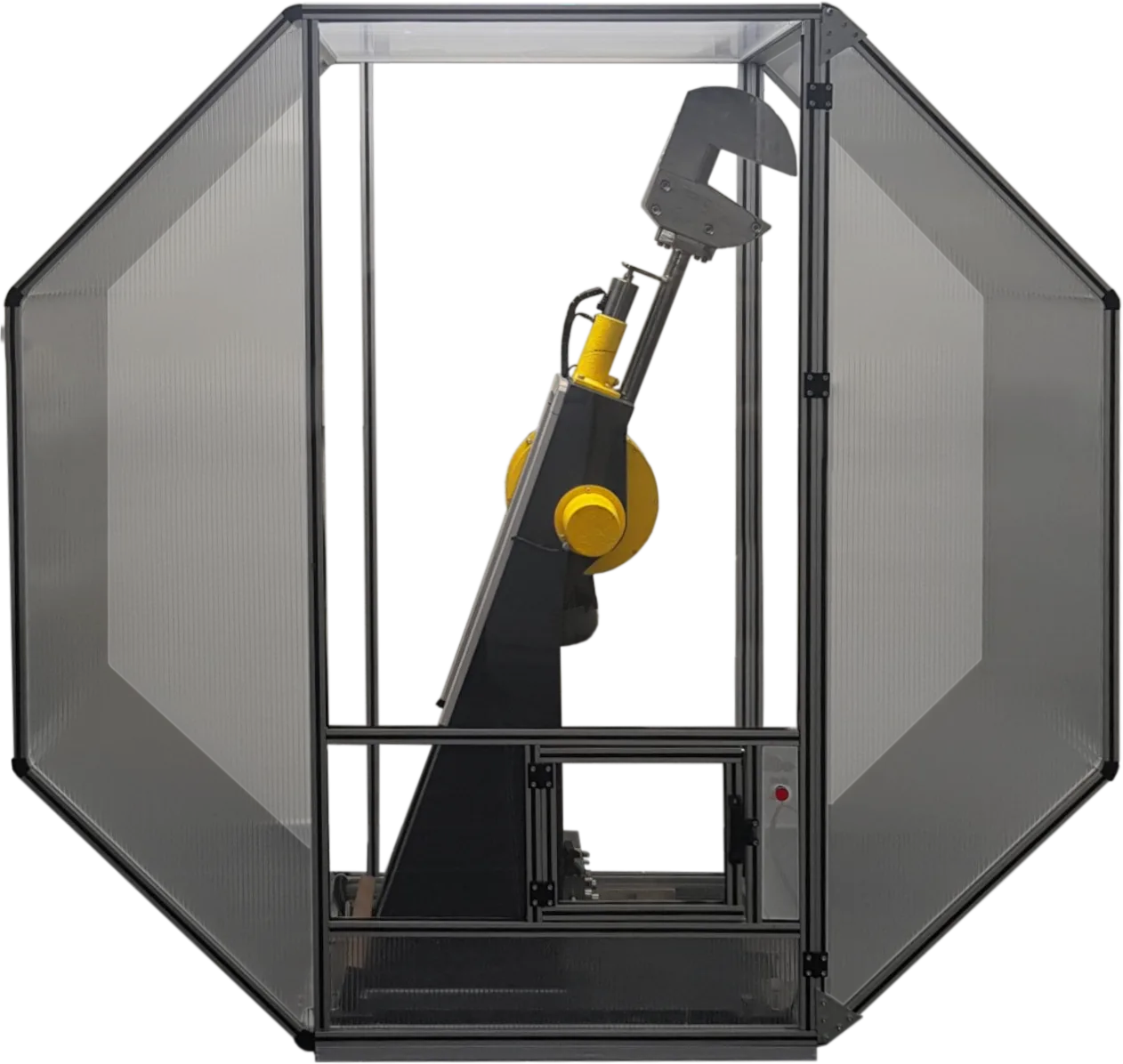
Vector pendulum impact tester for Izod absorbed energy on plastics, polymers and metals per ISO 180, ASTM D256 and ASTM E23 — from 5.5 J to 50 J.
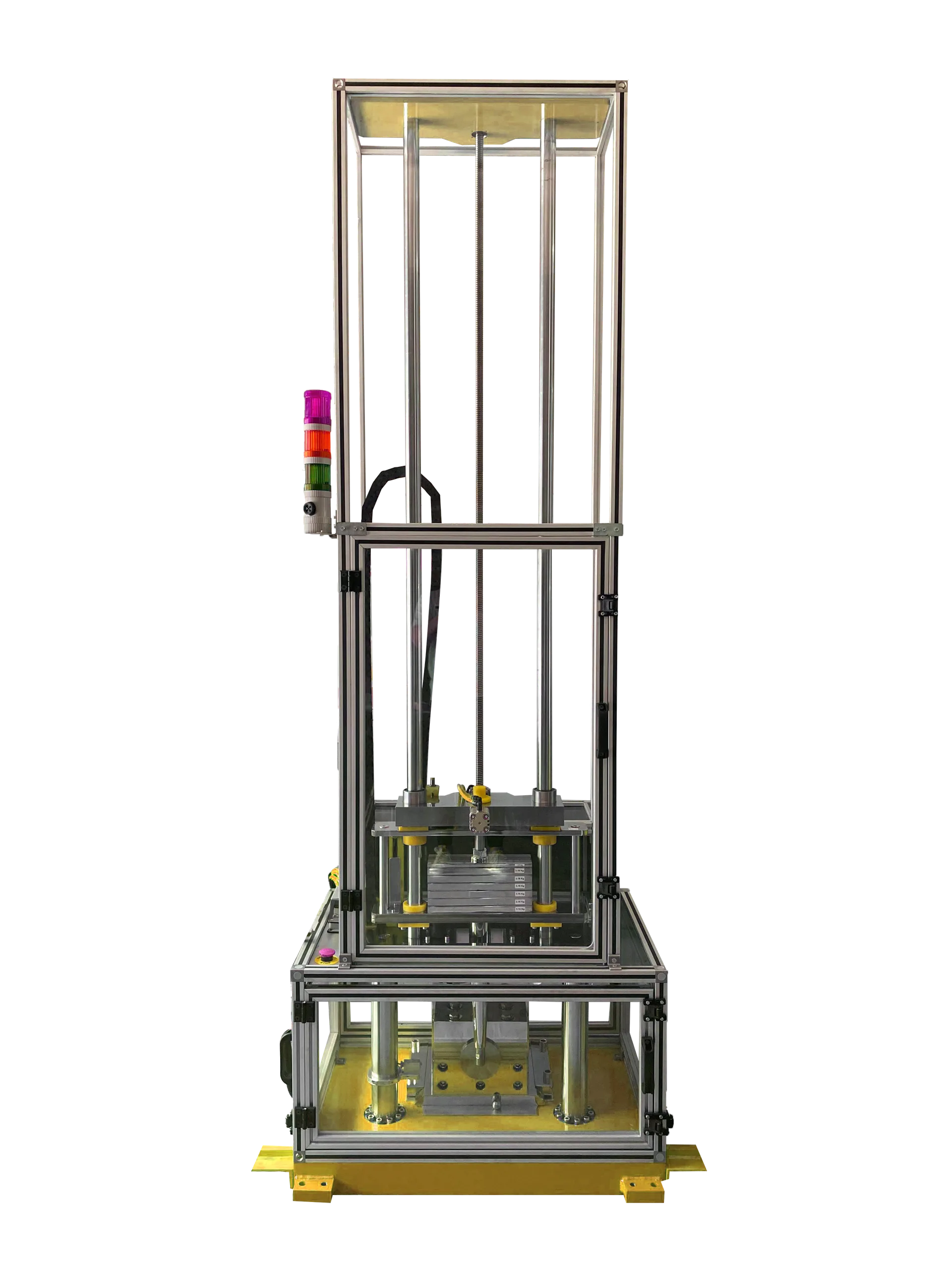
Vector VTR-17-0000 instrumented drop tower for plastics, composites and metals — 0.2 J to 2000 J impact energy, HMI control, and compliance with ASTM D3763, ASTM D7136, ISO 6603 and related standards.
Compute pendulum absorbed energy, machine capacity, and impact strength (kJ/m² or Izod J/m) from Charpy or Izod test inputs per ISO 148-1, ASTM E23, ISO 179-1, and ASTM D256.
Open calculator →