



News
Specimen Slippage and Axial Alignment Solutions for Tensile and Compression Testing
Grip and jaw face selection guide for accurate material testing — ASTM/ISO-aligned fixture strategies for metals, polymers, elastomers, composites, films, and cement specimens.
The accuracy of tensile, compression, and flexural test data depends not only on load cell quality but on how the specimen is clamped to the test axis. Wrong grip and jaw face selection causes specimen slippage, premature jaw break, and parasitic bending strains that invalidate results. This note outlines fixture strategies by material class for ASTM/ISO-aligned outcomes.
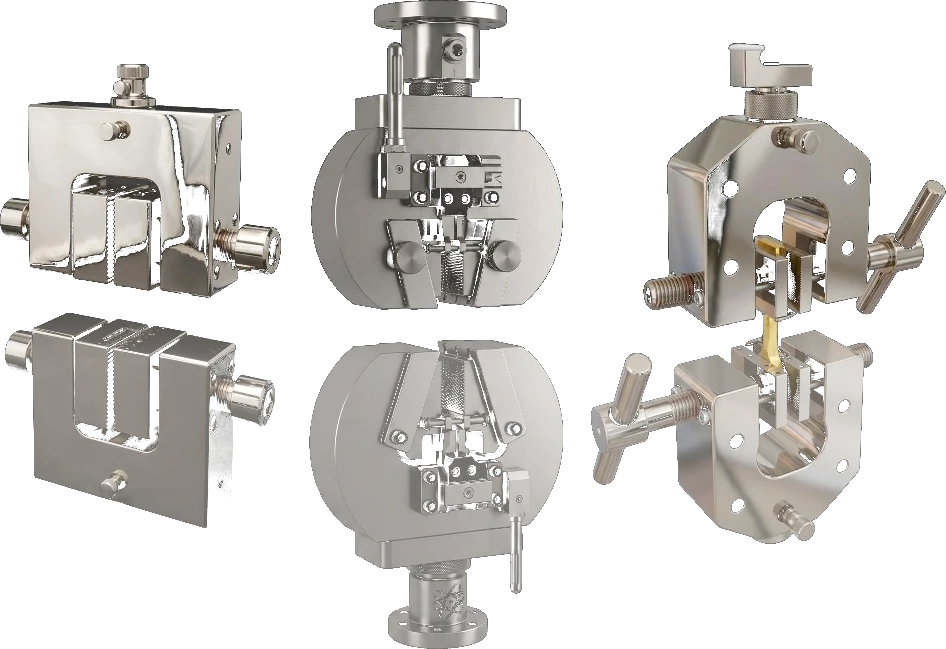
GRIPS & FIXTURES
Vector Grips & Fixtures
Pneumatic, wedge, hydraulic, and specialty fixtures from gram-force to meganewton capacity — designed and manufactured by Vector for Tesla Series UTMs and retrofit on major third-party frames.
View productCore technical challenges
Slippage and jaw break
Soft plastics, rubber, and thin films neck down during extension — manual screw grips cannot compensate and the specimen slips. On hard metals, excessive clamping force causes failure at the jaw line (jaw break). Both invalidate the stress–strain record.
Axial alignment and concentricity
Grips that are not concentric with the load axis apply an unwanted bending moment alongside tensile force. On high-strength metals and brittle composites, misalignment yields non-standard low strength results.
Extreme temperature behaviour
Tests from −70 °C to +250 °C in environmental chambers can lock jaw mechanisms through thermal expansion or degrade lubricants. Heat-treated alloys and chamber-rated fixtures are required in these programmes.
Grip and jaw face selection matrix
Use this matrix to match material class, test type, grip family, and jaw face. Linked columns open Vector grip detail pages.
| Material class | Test type | Recommended grip | Recommended jaw face |
|---|---|---|---|
| Hard metals, rebar | High-capacity tensile | Mechanical wedge , Hydraulic wedge | V-seat inserts (Serrated / V-groove) |
| Plastics and polymers | Tensile / flexural | Pneumatic side-action , Flexural fixtures | Serrated or rubber-lined |
| Rubber and elastomers | High-elongation tensile | Self-tightening roller , Pneumatic | Smooth rubber or corrugated |
| Composite materials | High-strength tensile | Parallel hydraulic , Mechanical wedge | Diamond-coated inserts (Diamond-coated) |
| Thin films, foil, paper | Low-capacity tensile | Manual screw , Light pneumatic , Pincer | Smooth rubber or flat metal |
| Cement and structural blocks | Compression / 3- or 4-point flexure | Fixed or swivel platens , Flexural fixtures | Hardened platens (Hardened flat surface) |
Alignment with international standards
Vector grips and fixtures are engineered to minimise specimen slip within these global test methodologies:
-
Metal tensile testing
For ASTM E8 / E8M and ISO 6892-1 , wedge and hydraulic jaw tooth geometry is produced at angles that resist slip at the yield point.
-
Plastics and composites
Under ISO 527 , ASTM D638, and ASTM D3039, pneumatic solutions and diamond-coated faces apply uniform pressure at the specimen shoulder.
-
Flexure and friction
ASTM D790 (plastic three-point flexure), ISO 679 (cement mortar prisms), and ASTM D1894 / ISO 8295 (coefficient of friction) rely on precision bearing fixtures for axial accuracy.
Universal adaptability
All grip and fixture solutions in this note integrate natively with Vector Tesla Series benchtop systems and hydraulic test frames. Custom adapter plates and couplings also mount to existing Instron, ZwickRoell, Shimadzu, or MTS equipment in minutes — extending your laboratory capability without replacing the frame.
Application FAQ
Can we change jaw faces without replacing the grip body?
Yes. Every Vector grip uses a quick-change insert system. Swap serrated, rubber-lined, or diamond-coated faces in seconds without hand tools.
Do you build fixtures for non-standard specimen geometry?
Yes. Vector R&D designs fully custom fixtures for tender specs and research projects with unusual part geometry.
What is the main advantage of pneumatic over manual screw grips?
Pneumatic grips hold air pressure constant throughout the test. As the specimen necks down, clamping force does not drop — mathematically suppressing slip.
Grips, fixtures & related resources
Browse Vector grip families, the full catalog hub, universal testing systems, and applicable standards.
Match grips to your materials and standards
Request a technical quote — our team will recommend jaw faces, capacity, and adapters for your UTM and test programme.
Request a quote