



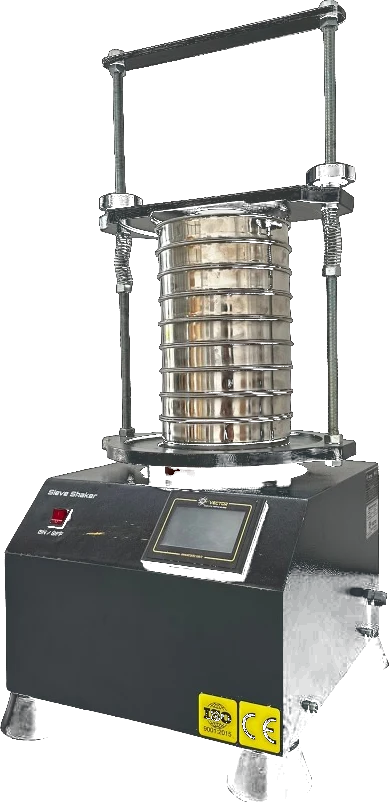
Analytical Sieve Shaker
Vector VTR-1041 analytical sieve shaker — controlled-amplitude vibration for reproducible particle size on 200 and 300 mm sieves per ASTM E11 and ISO 3310.
- astm-c1070
View details →
Particle size distribution determined by mass retained on a stack of standard sieves after controlled agitation, reported as percent passing or retained per ISO 565 / ASTM E11 sieve series.
Particle size distribution determined by mass retained on a stack of standard sieves after controlled agitation, reported as percent passing or retained per ISO 565 / ASTM E11 sieve series.
Sieve analysis characterizes particle size distribution of aggregates, powders, and soils by the mass fraction retained on each sieve aperture. Results support mix design, grinding control, and compliance with grading envelopes.
A sieve shaker agitates a nested stack for a defined duration; masses are weighed per tray. Fine fractions may require air-jet sieving when conventional shaking blinds fine meshes. Cement fineness per EN 196-6 Method 2 uses this principle — see the EN 196-6 summary and Alpine air jet sieve.
Use certified sieve cloth (ISO 565 / ASTM E11). Report dry or wet sieving, end-point criteria, and whether results are cumulative percent passing. For cement coarse-particle checks, see the 90 µm method in EN 196-6.
Overloaded sieves, damaged mesh, and incomplete cleaning between runs shift coarse/fine splits.
Vector VTR-1041 analytical sieve shaker — controlled-amplitude vibration for reproducible particle size on 200 and 300 mm sieves per ASTM E11 and ISO 3310.
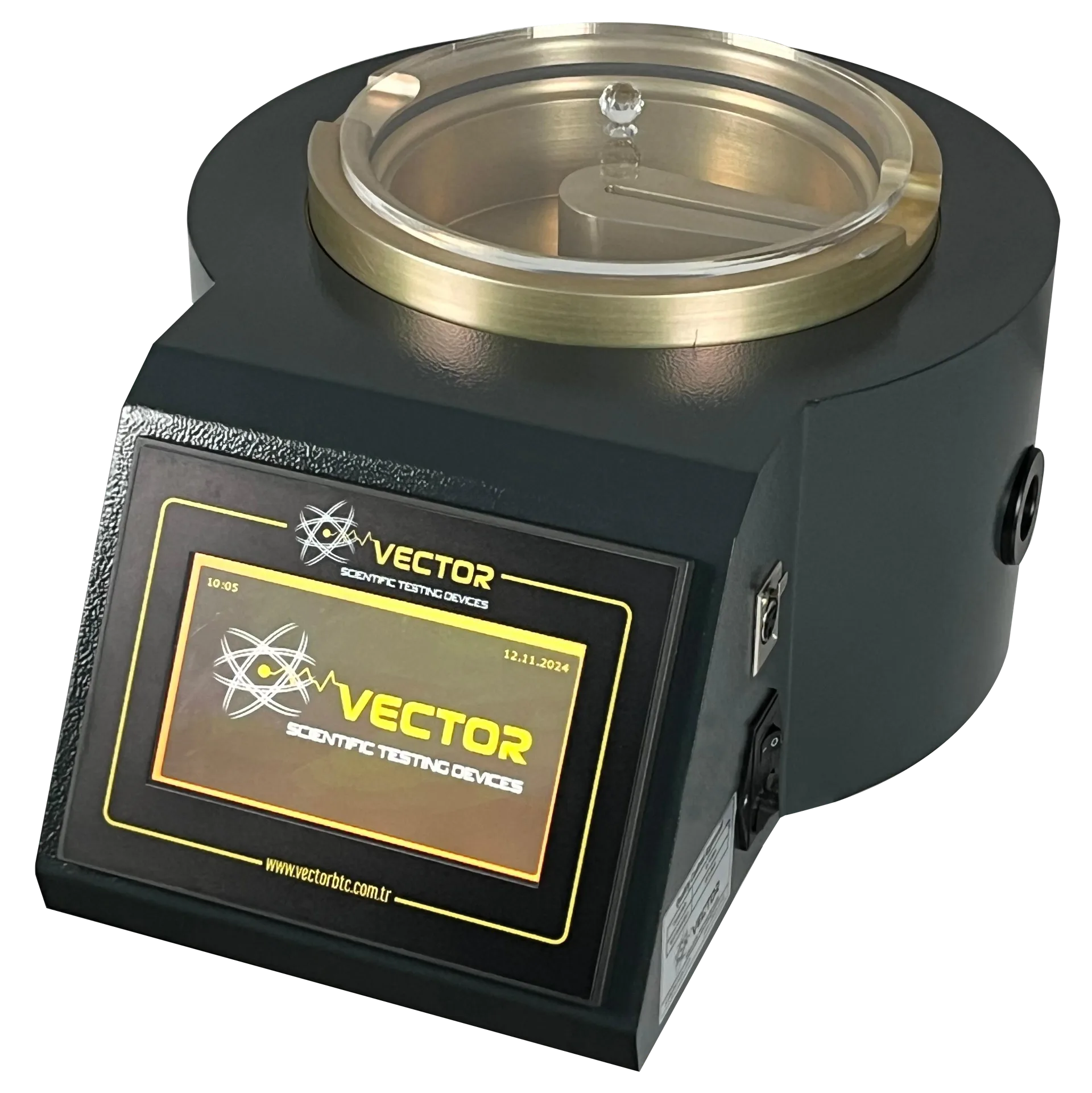
Vector VTR-1014 Alpine air jet sieve for fine powders from 10 µm to 4 mm — negative-pressure jet sieving per ISO 4610 for cement, minerals and food QC.
Blaine Fineness
Cement fineness index from air permeability through a packed powder bed, expressed as Blaine specific surface area (m²/kg) per EN 196-6 or ASTM C204.
Specimen Preparation
Cutting, grinding, and finishing steps that produce test pieces with required geometry, surface integrity, and alignment before mechanical, impact, or microstructural testing.